
What are Lootbound items?
Weapons, armor, accessories, and consumables that exist as rotatable grid shapes. They only work while equipped on that hero or companion. There are no fixed equipment slots.

Lootbound items are weapons, armor, accessories, and the odd consumable — not a slot list. Lootbound (ArtDock / Dreland Enterprises) gives every piece a geometric footprint. It only exists in a fight while it stays seated on that hero or companion. This wiki page is the category rulebook. Named uniques and a dumped 400-row catalog stay TBA. Verified August 15, 2026 · Steam.
| Fact | Detail |
|---|---|
| Platform | Steam · Win / macOS / Linux · Xbox Series |
| Genre | Pixel top-down tactical roguelite |
| Mode | Single-player |
| What an item is | A rotatable grid shape — no helmet / weapon / armor slots |
| Families | Weapons · Armor · Accessories · Consumables |
| Works when | Equipped on that character’s grid only |
| Loot card | A few offers; you move one item into a bag |
| Auras | Some pieces buff adjacent weapons or armor |
| High rarity | Legendary / Divine often carry directional auras — footprint still taxes |
| Full catalog | TBA — do not treat this page as a 400-name dump |
| Collection goal | Xbox achievement Collector reports “Discover 400 unique items” (60G) |
| Steam | App 3091140 · 20 achievements on the PC list |
Steam’s line is the definition: items do not have fixed slots. You rotate them and place them while a cell is free. A Lootbound items page is therefore a type guide, not a bestiary. The piece is a polyomino first and a stat stick second.
| What the tooltip shows | What it actually is |
|---|---|
| Name + rarity banner | Identity. Useful later; useless if the shape will not seat |
| Footprint | The real cost — bars, L-shapes, singles, large irregulars |
| Category / synergy line | Weapon, plate, helm, instrument, or a consumable — the lock auras care about |
| Self stats | What the piece is worth alone — usually the smaller half |
| Aura / adjacent text | A neighbor bonus, not a self-buff — auras |
| Class lock | Some rewards only fire on Warrior, Paladin, Witch, or Bard |
If ten helms fit, the game will let you wear ten helms. If a class-locked sword will not accept the current hero, it still occupies the same kind of cells on the companion who can swing it. Treat every drop as a shape that wants a home, then read the family.
A shape in the reward pile, a preview you cancelled, or a piece you kicked off the board to make room is not in the next fight. Companions follow the same rule. The inventory page is the packing ritual; this page is what you are packing.
Once you accept that the board is the catalog, the next screen to learn is the loot card — because you only get one seat.
After a win the card offers a short list. Demo and 1.0 clips repeat the same tutorial: move only one item from that card into an inventory, rotate to free space, discard the rest. The rest walk away. That is why category-reading happens before the drag.
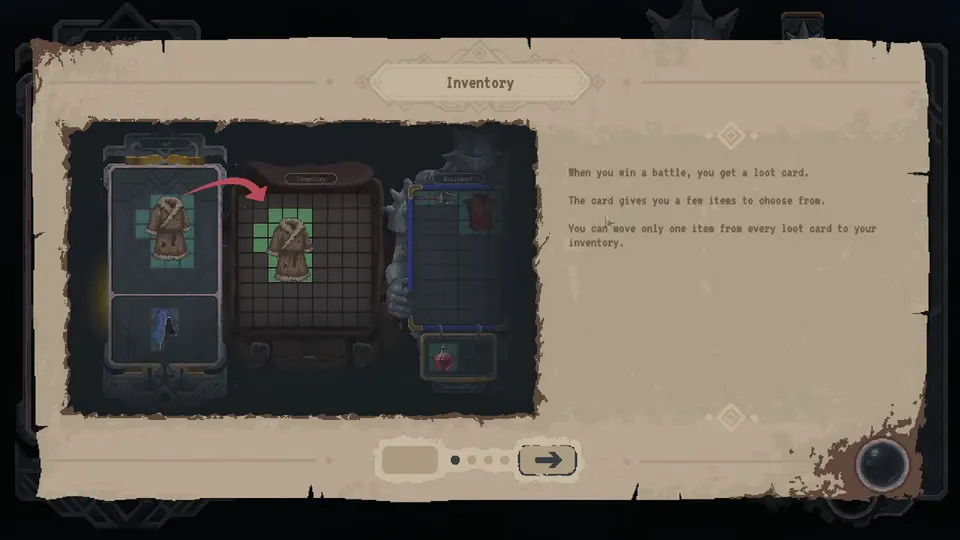
The in-game prompt is blunt about the one-item rule. Hovering a shape over empty cells is a test. If you leave the card without placing, you took nothing. If the outline stays red, you took nothing. A “full” screenshot of three pretty borders is still zero upgrades.
Later nodes can hand blacksmith gems that drag onto a seated piece to raise its stats. Playthroughs treat the enhance as permanent on that item. Do not spend a gem on a fringe you will discard next biome. Gem names and exact bonuses stay TBA — they modify a category you already packed; they are not a fifth family on this table.
If you do not know which family you just picked, the next section is the only index this wiki will publish until names are logged.
Community writeups and the in-game synergy line agree on four families. Subtypes you will see on tooltips — sword, plate, helmet, instrument — are locks, not a dumped unique list. Every named row below is a type. The full unique catalog is TBA.
| Category | What it is for | Typical lines | Pack note | Full list |
|---|---|---|---|---|
| Weapons | Offense. Aura magnets | Slash · Crush · Acid · Chaos · crit-style damage | Bars on an edge; keep a damage district | TBA |
| Armor | Survivability | Armor · Health · Resistance · Order · plate / helm locks | Defense district; Paladin lives here | TBA |
| Accessories | Utility hinges | Initiative · Order · Chaos · Dodge · crit chance · mana | Often one cell; do not bury them in the core | TBA |
| Consumables | One-use tools | Health potions · mana potions · bombs (community examples) | 1.0: hero grid — confirm companions still cannot seat them | TBA |
Weapons carry the offensive stats, and many auras only fire on a weapon type — swords-only is the usual example. That is why a compact common blade touching two legal auras can out-hit a louder spear parked on the far edge. [Into Indie Games](https://intoindiegames.com/walkthroughs/tips-tricks/lootbound-beginners-guide/) makes the same point: moving a weapon one tile can be the upgrade. Exact weapon names stay off this table on purpose.
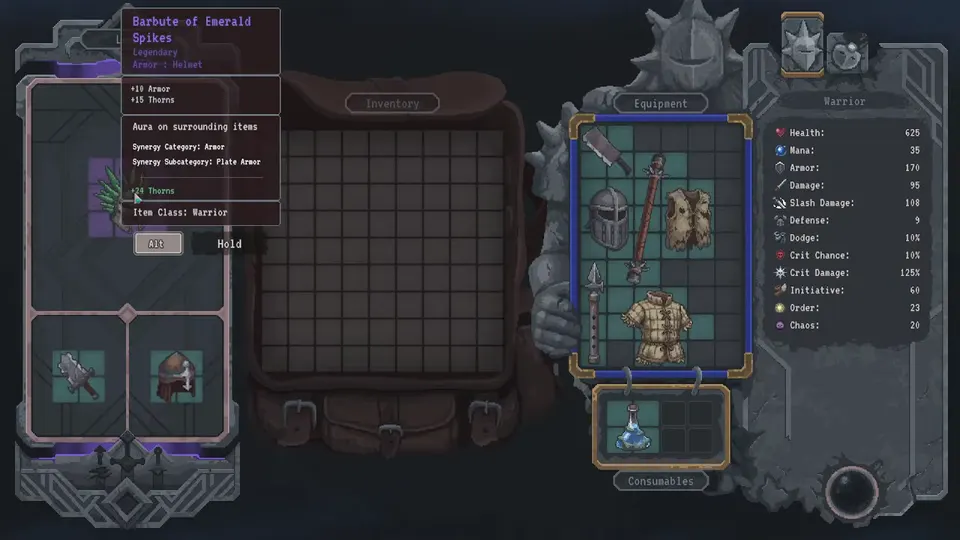
Armor pieces stack Armor, Health, Resistance, and the defensive bonuses Paladin kits want. Playthroughs also show a plate lock and a helmet lock as separate synergy lines — a thorns aura that only paints plate will ignore a generic “armor” neighbor. Steam never reserved a head row. If four helms fit and the aura wants helms, four helms is a legal kit.
Accessories are why Initiative, Order, and Chaos show up on a board that already has a sword. Consumables are the drinks and bombs. Both look skippable next to a legendary bar. Both are how a run actually lasts. Details sit in the two sections after the keep-or-drop table.
Before you chase a gold border, learn why the banner is the last column.
Reviews of the 1.0 loop keep repeating the same tax: Legendary and Divine pieces are the tiers most likely to project a directional aura — a high-tier sword that buffs the weapon below it is the usual picture. The footprint is still the cost. A legendary irregular that deletes three contacts is a downgrade even when the tooltip is louder.
| Banner | What players report | What you should do |
|---|---|---|
| Common / uncommon compact | Often the piece that sits in two auras | Keep if it feeds the district |
| Rare with a clean bar | Easy edge piece; may lack an aura | Keep as a border if the type matches |
| Legendary / Divine + legal lock | Directional aura is the real prize | Seat the emitter, then wrap legal neighbors |
| Legendary / Divine irregular | Can wipe a plus-shaped hole | Drop unless one slide saves the cluster |
| Cannot-rotate aura | Facing is locked | Build around it — do not force a rebuild for the banner |
The full rarity ladder and every unique name stay TBA. Do not plan a run around a copied “+40 on four swords” story problem. One recorded tooltip mixed several stats on a single un-rotatable piece — tradeoffs exist, and the live number is whatever that item says today. Count legal neighbors. Then open auras if the glow is the part you still do not trust.
Use this after you have named the family. Stats are the last column. A legendary that deletes two aura contacts is a downgrade even when the border is gold.
| Situation | Keep | Drop | Rotate / slide |
|---|---|---|---|
| Weapon that fits the damage district | Yes, if Slash / Crush / Acid / Chaos matches the biome | If it is a tourist type in a working cluster | Bars along the rim, not through the plus |
| Armor that feeds plate / helm | On the tank or the body that is dying | On a slasher who needed a weapon cell | Slide until the lock actually touches |
| Accessory with Initiative / Order / Chaos you lack | Yes, on the fringe | If it is a spare you are “saving” | Single cells are hinges — keep two empty if you can |
| Consumable on a full hero bag | If it is the last heal or mana you will spend | Duplicates you will not click this biome | Never test it on a companion grid |
| Legendary irregular, working cluster | Only if it replaces both jobs the cluster was doing | Default | Try every facing first; one slide can save the pair |
| Class-locked to someone else | On that companion’s grid | On the hero — it will never fire | Do not waste hero cells testing it |
| Duplicate of a seated piece | Only when the copy enables a second aura | When it is pure overlap | Stack them only if the lock wants that type twice |
What family is it? Does it feed an aura I already seated? What do I throw out to make room? If the answer to the last one is “the cluster that is carrying the run,” leave the drop on the floor. Inventory space is the scarce currency — gold-bordered Lootbound items are not.
Steam wants a separate set of equipment for the hero and each companion. If the hero is dense and a Paladin is hollow, “keep” can mean “keep, but not here.” That is also why accessories deserve their own pass — they are the pieces that change who acts first.
Matched by build plan, shared topics, and guide progression — not random related links.
Yes — that is the usual job. [Into Indie Games](https://intoindiegames.com/walkthroughs/tips-tricks/lootbound-beginners-guide/) groups accessories as utility: Initiative, Order, Chaos, Dodge, critical chance, and mana. They rarely win a tooltip contest against a sword. They decide whether the sword gets to swing.
| Accessory job | Why you seat it | Where it sits |
|---|---|---|
| Initiative | Who acts first on the bar — often the hero you click | Fringe or a single-cell gap near the body that should move |
| Order | Amplifies heals, armor repair, blessings — Paladin language | Next to plate, not next to a Chaos curse kit |
| Chaos | Amplifies curses and other negative effects — Witch language | On the Witch grid; keep it off Paladin plate |
| Dodge / crit / mana | Secondary defense, crit kits, or run-extending refunds | Utility corner — do not split the damage plus |
You cannot drag a companion earlier on the combat bar. You pack Initiative onto the body that should move first. Accessories are the usual seat. Named rings and charms stay TBA. If the Paladin’s hold lands after the Witch’s curse, the round was packed backwards — combat is the turn-order page; this page is why that accessory was on the wrong grid.
Do not sprinkle both on one board and hope they average out. Order wants the armor district. Chaos wants the curse kit. A single accessory that lists both is a tradeoff, not a free win — read the line, then pick a side. Damage-type matchups that those stats feed sit on damage types.
The last family is the one new players park on a companion and then cannot drink.
1.0 tutorial / play: companions can wear gear; drinks stay on the hero. Health potions, mana potions, and bombs — the examples community guides keep naming — live on the hero grid. Treat that as the default until a patch says otherwise.
| Piece | Which grid | Why |
|---|---|---|
| Weapon / armor / accessory | Hero or the matching companion | Class locks still apply; rotate to fit |
| Consumable | 1.0: hero grid | You only click the hero — a drink on a recruit is wasted cells |
| Blacksmith gem | Onto a seated keeper | Enhances an item you will still own next biome |
Consumables are temporary. Park them on the fringe or in a single-cell gap so using one does not rip a hole through the damage cluster. Xbox also lists Alchemist’s Apprentice — buy fifteen consumables in the Hub — which is how we know drinks are a real meta category, not flavor. A two-consumable carry cap stays TBA until we log the 1.0 bag.
Because combat is hero-only, a potion on the hero is the only potion you can spend. A “full” companion grid stuffed with drinks is a misread of Lootbound items, not extra storage. If the hero bag is the bottleneck, drop a fringe accessory, not the last heal.
Which leaves the question every wiki visitor types next: how many items are there, really?
Public Xbox achievement lists report a Collector goal: Discover 400 unique items (60 Gamerscore). That is a collection target, not a spreadsheet we can paste. This wiki will not invent a 400-name dump to look complete. The live unique count, per-biome tables, and every official name stay TBA until we log the 1.0 index.
| Claim | What it is | How this page treats it |
|---|---|---|
| ~400 unique items | Xbox Collector achievement text, as reported | Cite as a hunt goal — not a catalog |
| 20 Steam achievements | PC achievement count on the Steam listing | Hunt page: achievements |
| Alchemist’s Apprentice | Buy 15 consumables in the Hub (Xbox / achievement lists) | Confirms consumables as a real family |
| Named uniques | Not published by ArtDock as a public database | TBA — memorize families and locks |
| Per-type counts (93 weapons, …) | Fan tracker mockups, not official splits | Ignore until we have a logged index |
A first expedition is a packing puzzle. You will not see 400 shapes, and you should not reroll a working kit to “discover” a banner. If you are hunting Collector later, keep a mental note of families you have never seated — a new accessory lock is a discovery; a third copy of the same sword is not. Confirm the live wording on Xbox and Steam before you treat 400 as a patch-proof number.
When a reliable 1.0 dump exists, this page grows into a filterable index — name, family, shape, lock, aura side — not a wall of guessed titles. Until then, the useful page is the one that teaches you to refuse a legendary that does not fit. The last pass is the mistake list.
Scan this before the next loot card. Each row is a category error, not a combat error.
| Mistake | Fix |
|---|---|
| Treating the bag as a 400-item checklist | Pack the family in front of you. Collector is a later hunt |
| Seating rarity before footprint | Rotate first; drop the legendary if it breaks two auras |
| Ignoring the synergy line | Sword / plate / helm / instrument locks are the aura’s audience |
| Parking a class-lock on the wrong body | Open that companion’s grid — classes |
| Consumables on a recruit | Move them to the hero — 1.0 companions could not seat drinks |
| Forcing a second item off one loot card | You only get one seat per card — discard the rest |
| Saving “just in case” junk | Empty cells are future auras. Discard the spare |
| Sprinkling Order and Chaos on one board | Pick a side. Paladin plate and Witch curses do not average |
| Gemming a fringe you will sell | Enhance a keeper. Blacksmith is permanent on that piece |
| Chasing a dumped fake wiki list | If a site names 400 uniques with no source, close it |
Before you leave the card, say the family out loud, then look at the grid that can use it. If the outline is green and the lock matches a neighbor, seat it. If the glow dies, slide. Then take the sequel page — the backpack is how these Lootbound items become a build.
Weapons, armor, accessories, and consumables that exist as rotatable grid shapes. They only work while equipped on that hero or companion. There are no fixed equipment slots.
The full unique catalog is TBA. Public Xbox achievement lists report Collector — Discover 400 unique items (60G). Treat ~400 as a reported collection goal, not a dumped wiki list.
Weapons carry offense and most damage auras. Armor carries Armor, Health, Resistance, and plate / helm locks. Accessories are utility — Initiative, Order, Chaos, Dodge, crit, mana.
No. Legendary and Divine pieces often carry directional auras, but a huge irregular that breaks two contacts is a downgrade. Shape and lock beat the banner.
No. Companions can wear gear. Consumables typically stay on the hero grid only — you only click the hero in combat.
One. Move a single item onto a grid, then discard or walk away from the rest.
No. Steam: rotate and place as long as a cell is free. Ten helms is legal if they fit and an aura wants helms.
Keep Initiative if turn order is wrong, Order on Paladin plate, Chaos on a Witch curse kit, and mana refunds if you are going dry. Named pieces stay TBA.
Not as a public ArtDock dump at launch. This wiki will not invent names to fill the gap. Check Steam and the Xbox store listing for systems copy.
The inventory page — rotate, seat, then leave. Aura adjacency is on auras.
August 15, 2026
Matched by build plan, shared topics, and guide progression — not random related links.