
What are Lootbound auras?
Neighbor-tile bonuses on equipped items. Some pieces strengthen weapons or armor in adjacent cells. Move one piece and the whole kit can change.

Lootbound auras guide: adjacent tiles buff weapons and armor. Slide one cell to rewrite the kit; drop a legendary that breaks the cluster. Verified August 2026.
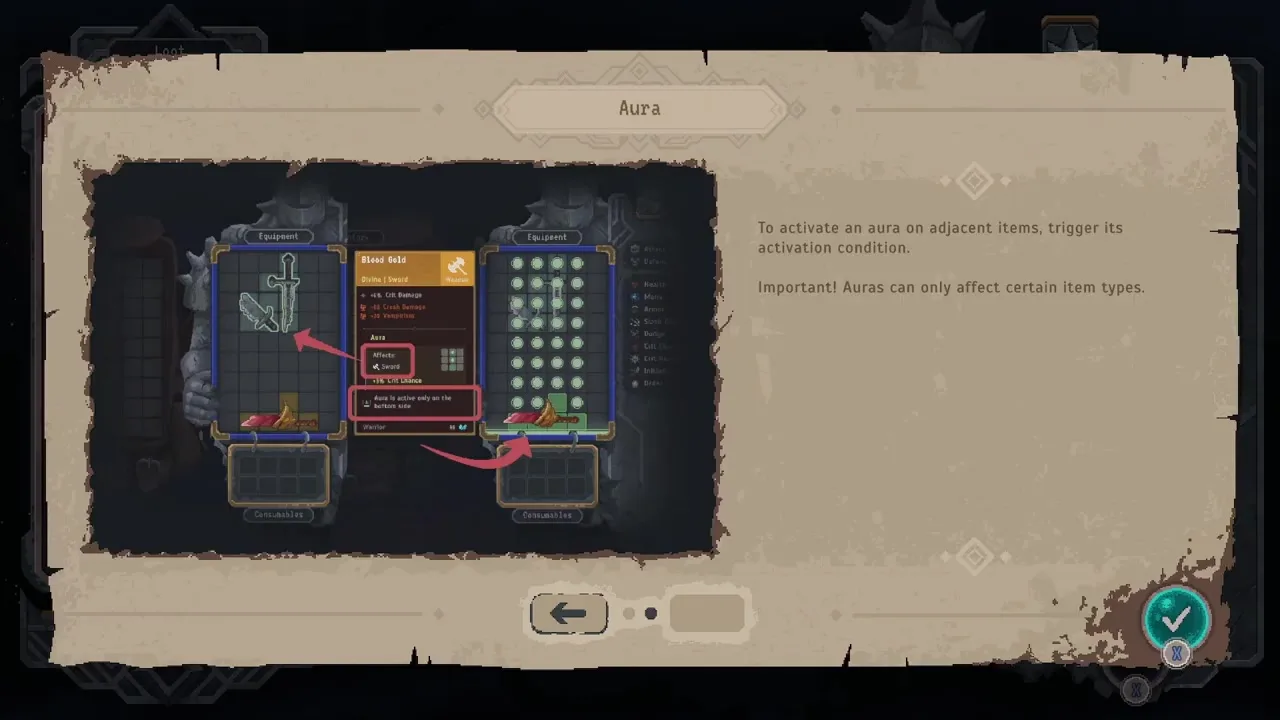
Watch the aura prompt: bonuses hit adjacent cells, only matching item types, then a pack that seats the piece in the middle.
~13 min read
Lootbound auras are neighbor bonuses, not self-buffs. Lootbound (ArtDock / Dreland Enterprises) lets some items strengthen weapons or armor in adjacent cells — Steam’s own line is that moving a piece one cell can rewrite the whole kit. This page is the adjacency rulebook: who an aura may touch, which side it faces, and when a pretty pack is a dead glow. Verified August 15, 2026 · Steam.
| Fact | Detail |
|---|---|
| Platform | Steam · Win / macOS / Linux · Xbox Series |
| Genre | Pixel top-down tactical roguelite |
| What an aura is | A bonus projected onto neighboring equipped items — not a self-stat |
| Range | In-game prompt: items above, left, right, and below (cardinal). Diagonals TBA |
| Must fire | Activation conditions + a matching item type on a legal side |
| Target locks | Community-logged: swords only · plate only · instruments only · some helms / hats |
| One-cell rule | Steam: moving a piece one cell can change the entire build |
| High rarity | Legendary / Divine often carry directional auras — footprint can still lose |
| Party | Hero and each companion keep a separate grid. Auras do not jump characters |
| Exact values | Per-item numbers stay TBA — do not plan around a copied +40 |
Steam’s copy is the definition: items become powerful when they affect one another, and some pieces have item auras that strengthen weapons or armor in adjacent cells. The grid is the build. A number on a lonely legendary is a suggestion until a legal neighbor sits in the aura’s area of effect.
| What you see | What it actually is |
|---|---|
| Glow / aura text | A neighbor contract. Empty cells and wrong types do not collect |
| Self stats on the piece | What the item is worth alone — usually the smaller half |
| Area of effect | The cells the tooltip names. Cardinal is confirmed; treat extras as TBA |
| Activation line | The lock: adjacent only, swords, plate, instruments, helms… |
| One-cell slide | The cheapest rebuild. Steam warns it can rewrite the kit |
The in-game prompt is blunt: items with auras grant bonuses to adjacent items inside their area of effect, and you must trigger the activation conditions. That is why a compact common sword touching two legal auras can out-hit a louder blade parked on the far edge. The bonus is per legal neighbor, not a room-wide buff you collect by owning the piece.

If the outline is still red, you do not have an aura problem — you have a packing problem. Rotate and seat first on the inventory grid, then come back here. Lootbound auras only exist on equipped cells.
Once the piece is down, the next failure is quieter: the glow is on, and nothing changed.
New players read a fat bonus and assume every touching tile collects it. Wrong. The prompt says auras can only affect certain item types. A swords-only field next to plate, or an instruments-only field next to a Warrior slash bar, is a lit empty room.
| Symptom | Usual cause | Fix |
|---|---|---|
| Fat tooltip, same fight | Neighbor is the wrong class (plate in a swords field) | Read the type lock; swap the neighbor, not the aura |
| Glow on one side only | Directional aura — one recorded piece was “active only on the left” | Rotate the emitter if it allows; else slide the target onto that side |
| Aura text, no bonus | The piece never stayed equipped, or you overwrote its cells | Reseat; unequipped loot is not in the fight — inventory |
| Works on the hero, dead on the recruit | Separate grids. Auras do not cross characters | Pack the same idea on that companion’s board |
| Cannot twist the emitter | Some aura items cannot be rotated | Build the neighborhood around the locked facing |
| Looks adjacent, still dead | Diagonal touch, or a gap cell between pieces | Need a shared edge. Confirm diagonals as TBA |
What type does it activate? Which side does it work from? How many pieces can it reach? Community guides log the same locks you will see on tooltips: equipment adjacent only, plate only, swords only, instruments only. Playtests also show helm / hat locks. Exact item names stay TBA on the items index — memorize the lock, not a fake catalog.
The tutorial lists above, left, right, and below. That is the default neighborhood. If a later piece names a single side, that line wins. Do not assume a plus-shaped splash just because the last aura had one.
If the lock is clear and the glow is still dead, the next job is placement — center, not corner.
Do not drop an aura in the first hole that fits. Identify the two to four pieces that can legally use it, then build the hole around that cluster. A good aura jammed against an edge with one neighbor is a wasted legendary.
| District | What belongs there | What the aura should improve | Keep out |
|---|---|---|---|
| Damage | Main weapons and offensive trinkets | Slash / Crush / Acid / Chaos or crit-style lines on the tooltip | Potions you will spend this biome |
| Defense | Armor, shields, mitigation | Armor, Health, Resistance, Order on plate | One-off utility that splits the cluster |
| Utility | Mana, Initiative, situational tools | Recovery, exhaustion, setup stats | The primary weapon if it needs a different lock |
A middle cell can share more edges than a corner. Seat the aura, then wrap legal pieces around it. Long bars belong on the rim so they do not cut the plus-shaped hole a future neighbor needs. That packing habit lives on inventory; the aura habit is: never isolate the emitter.
Early writeups call this zoning. You do not need named uniques to do it. One damage aura touching two compact weapons already beats three unrelated glows on three lonely tiles. Keep a small utility fringe so the next loot card has a hinge.
When a new shape is “almost” right, do not wipe the district. The mid-page table is the slide / keep / drop call.
Use this after the outline is green and the tooltip is read. Stats are the last column. A one-cell slide is the default; a full wipe is for a dead kit or a biome gate.
| Situation | Slide one cell | Keep as-is | Drop / rebuild |
|---|---|---|---|
| Aura lit, one neighbor illegal | Yes — swap that neighbor onto a legal side | If a second legal piece already sits opposite | If no legal type exists on this character |
| Fits only by breaking two contacts | Try every facing first | No | Default — unless the new piece replaces both jobs |
| Better raw stats, worse footprint | Park it on a companion who has the hole | If you are empty on that stat | If the old shape feeds two auras |
| Directional “left only” aura | Slide the target onto that side | If the target already sits there | If the emitter cannot rotate and the side is blocked |
| New legendary irregular | Only if one slide saves the district | Never for rarity alone | If it deletes three contacts |
| Duplicate of a seated piece | Stack only if the aura wants that type twice | When the copy enables a second lock | Pure overlap |
| Wrong damage type for the next biome | Slide it into a Crush / Acid district — damage types | If the old type still clears this node | If the whole district speaks one language |
| Companion bag is hollow, hero is dense | Move the aura to the recruit who can use the lock | Hero keeps the working cluster | Do not clone the hero kit onto every grid |
What type does it buff? Does a legal neighbor already exist? What contact dies if I force the new shape? If the last answer is “the cluster carrying the run,” leave the drop on the floor. Empty cells are future Lootbound auras, not wasted space.
Rebuild when a Boss Part or a new recruit changes the job, not after every loot card. The builds page is the sequel for committing a lane; this page is the one-cell habit that keeps that lane alive.
Matched by build plan, shared topics, and guide progression — not random related links.
Community reviews treat Legendary and Divine as the tiers most likely to project a directional aura — a high-tier sword that buffs the weapon below it is the usual example. That does not make the gold border an upgrade. The footprint is the tax.
| Drop | Keep when | Leave on the floor when |
|---|---|---|
| Compact legendary / divine with a legal lock | It sits in the district and adds a side you lacked | It forces a 3×3 hole through two working contacts |
| Awkward irregular, loud tooltip | A companion bag has the exact hole | The hero cluster would have to die to seat it |
| Common piece inside two auras | Always, until a compact replacement does both jobs | Never “just because rarity” |
| Cannot-rotate aura | The facing already points at your weapons or plate | You would have to rebuild the whole plus to aim it |
Into-the-run writeups keep repeating the same test: what shape is it, does it feed an aura you already seated, and what do you throw out? If the answer is the cluster, the legendary is the downgrade. Treat the full rarity ladder and every named unique as TBA — the rule is the contact count, not the banner.
Some guides invent tidy “+40 damage on four swords = +160” math to teach the idea. Useful as a picture, useless as a catalog. One recorded tooltip mixed Acid, Initiative, Order, and Chaos on a single un-rotatable piece — tradeoffs exist, and the live number is whatever that item says today. Log values on items when we have them; until then, count legal neighbors.
Those neighbors also decide which damage language the kit speaks.
A one-cell slide can change more than a flat number. Seat a Crush aura against a Slash bar and the next plated enemy finally dies; slide it off and you are tickling armor again. Lootbound auras are how damage types move without a new weapon.
| Type | What it does | Aura job |
|---|---|---|
| Slash | Cuts Health once armor is gone | Stack on the weapons you swing after Crush / Acid opens the plate |
| Crush | Breaks armor | Keep at least one Crush contact if the biome is plated |
| Acid | Skips armor, hits Health | Witch-friendly; one Acid neighbor can save a Slash-only hero |
| Chaos | Strengthens debuffs | Pair with Witch / curse kits — do not sprinkle onto a Paladin Order block |
| Base | Untyped leftover | Fills gaps; do not rebuild a district just to chase it |
A damage district that only speaks Slash stalls on armor. Keep Crush or Acid in the same neighborhood, or on the first recruit. Order and Chaos pull opposite ways — Paladin plate wants Order, Witch kits want Chaos. Do not let one aura paint both. Full matchups: damage types.
You still only click the hero. If the aura rewrite happened on a companion bag, that companion’s automatic turn is what changed — not your hotbar. Check the pane after the slide, then take the node.
Which is why a second grid is not a second copy of the hero’s glow.
Steam: collect a separate set of equipment for the hero and each companion. Item auras live on that board only. A Bard instrument lock does nothing on the Warrior grid, and a Paladin plate aura does not leak onto the hero.
| Grid | Aura plan | Typical lock |
|---|---|---|
| Hero (you click) | The district you spend Mana on | Whatever the starting class actually swings |
| Warrior recruit | Damage district — Slash / crit-style | Swords and offensive neighbors |
| Paladin recruit | Defense district — Armor, Order | Plate; keep Chaos off this bag |
| Witch recruit | Acid / Chaos / Mana | Do not park Bard instruments here |
| Bard (Jester alias) | Support — judge the party, not personal damage | Instruments; Order over Chaos |
Warrior wants the swords field. Paladin wants plate. Witch wants the Acid / Chaos neighbor. Bard wants instruments and the pieces that make everyone else hit or live. Some writeups say Jester — this wiki uses Bard and notes the alias. Roles: classes.
Companions typically cannot equip consumables. A potion parked beside a damage aura is a wasted edge, and it will not fire from a companion bag. Keep drinks on the hero fringe.
The last pass is a short list of glow errors that look like bad loot.
Scan this before the next loot card. Each row is an adjacency error, not a combat error.
| Mistake | Fix |
|---|---|
| Assuming every neighbor collects the bonus | Read the type lock — swords / plate / instruments / helms |
| Parking the aura in a corner | Move it in until it has more than one legal edge |
| Seating rarity before contact count | Keep the common piece that sits in two auras |
| Treating diagonal touch as adjacent | Need a shared side until a tooltip says otherwise |
| Cloning the hero glow onto every recruit | Pack the role — classes |
| Forcing a cannot-rotate emitter to a new facing | Build around the locked side |
| Sprinkling three half-districts | One tight damage cluster plus a defense block |
| Rebuilding after every drop | Slide one cell. Full wipes are for dead kits |
| Ignoring the damage-type line on the aura | A Crush field in a Slash-only bag is a tourist — damage types |
| Planning around a blog’s +40 example | Count legal neighbors. Exact values stay TBA |
Before you leave the screen, look at each glow and ask whether a legal neighbor still shares an edge. If a lock died, slide; if a piece is lonely, drop it. Then take the sequel — adjacency is how a builds lane stays a lane, and the inventory page is where the next shape has to fit.
Neighbor-tile bonuses on equipped items. Some pieces strengthen weapons or armor in adjacent cells. Move one piece and the whole kit can change.
The projected bonus is for legal neighbors. Self stats still apply, but the aura contract is adjacency — empty cells and wrong types collect nothing.
The in-game prompt lists items above, to the left, to the right, and below. Some auras are one-sided. Treat diagonals as TBA unless a tooltip names them.
Wrong item type, wrong side, a gap cell, or the piece never stayed equipped. Swords / plate / instruments / helm locks are common.
They often project directional auras, but an awkward footprint that deletes contacts is a downgrade. Count legal neighbors, not the banner.
No. Some aura pieces cannot be rotated. Build the neighborhood around the locked facing.
No. The hero and each companion have separate grids. Pack the lock on the character who can use that item type.
A slide can change which damage type the neighborhood actually deals. Keep Crush or Acid in the party if the biome is plated.
No. Slide one cell first. Full wipes are for dead kits, new recruits, and biome gates.
The inventory guide — rotate until it equips. Then come back here for the neighbor rules, or open builds to commit a lane.
August 15, 2026
Matched by build plan, shared topics, and guide progression — not random related links.