
What is the best Lootbound build?
There is no verified ranked list. Start from class + aura adjacency + a damage type the next biome respects. Cover Slash or Acid/Crush across the party, not on every grid.

Lootbound builds: stack adjacent auras, cover Slash Crush Acid or Chaos, and split Warrior Paladin Witch Bard grids. Commit a lane — no fake S-tier ranked kits.
Watch a first-run lane: seat Acid onto a Slash-leaning hero, then slide Crush onto the Warrior grid.
~13 min read
This page answers Lootbound builds as synergy, not a ranked loadout list. Lootbound (ArtDock / Dreland Enterprises) has no official S-tier kits: a build is the aura contacts that fire, the damage type those contacts speak, and the three class grids that do different jobs. Named uniques stay TBA. Verified August 15, 2026 · Steam.
| Fact | Detail |
|---|---|
| Platform | Steam · Win / macOS / Linux · Xbox Series |
| Genre | Pixel top-down tactical roguelite |
| What a build is | Aura adjacency + a damage language + three separate party grids |
| What it is not | A named unique loadout or an official S-tier screenshot |
| Damage types | Slash · Crush · Acid · Chaos · plus untyped Base |
| Classes | Warrior · Paladin · Witch · Bard (Jester alias) — 1.0 parties usually field three of four |
| Grids | Hero and each companion keep a separate board. Auras do not jump characters |
| Control | You click the hero only. Companions resolve from initiative |
| Item names | Full catalog TBA — pack the lock and the type, not a fake unique |
| Verified list | None. Community lanes below are jobs, not ranks |

Steam’s line is the whole definition: items become powerful when they affect one another, and moving a piece one cell can rewrite the kit. A Lootbound build is that rewrite made on purpose — not a portrait, not a rarity banner, and not a blog’s invented unique list.
| What people search | What actually exists |
|---|---|
| “Best Lootbound builds” as a ranked kit | No verified S-tier list. Lanes below are jobs |
| A named sword + named helm screenshot | Item names stay TBA on the items index |
| One hero loadout that wins every biome | Three grids. The leftover class sits out |
| Rarity as the upgrade | A compact common inside two auras often wins |
| A skill-tree preset in the hub | Barracks helps the opener. The grid is still the build |
Part one is auras: a bonus that only fires on a legal neighbor. Part two is a damage language — Slash, Crush, Acid, or Chaos — that the next plated elite actually respects. Part three is the party: Warrior, Paladin, Witch, and Bard each wear their own board, so cloning the hero kit twice is not synergy.
Community writeups keep repeating the same contrast: a bag of gold-border pieces with no contacts loses to ordinary shapes that share edges and speak one language. Ask whether the new piece activates more auras, whether it matches the type you already seated, and whether its footprint deletes a working cluster. If the last answer is yes, the floor is the upgrade.
That test is useless until you pick a first language. The next section is the opener, not a favorite unique.
Do not lock a named kit in the hub. Pick the body you can play solo, survive the first nodes, then commit one language on the hero grid before the first companion room. The beginner guide is the expedition loop; this page is only the lane.
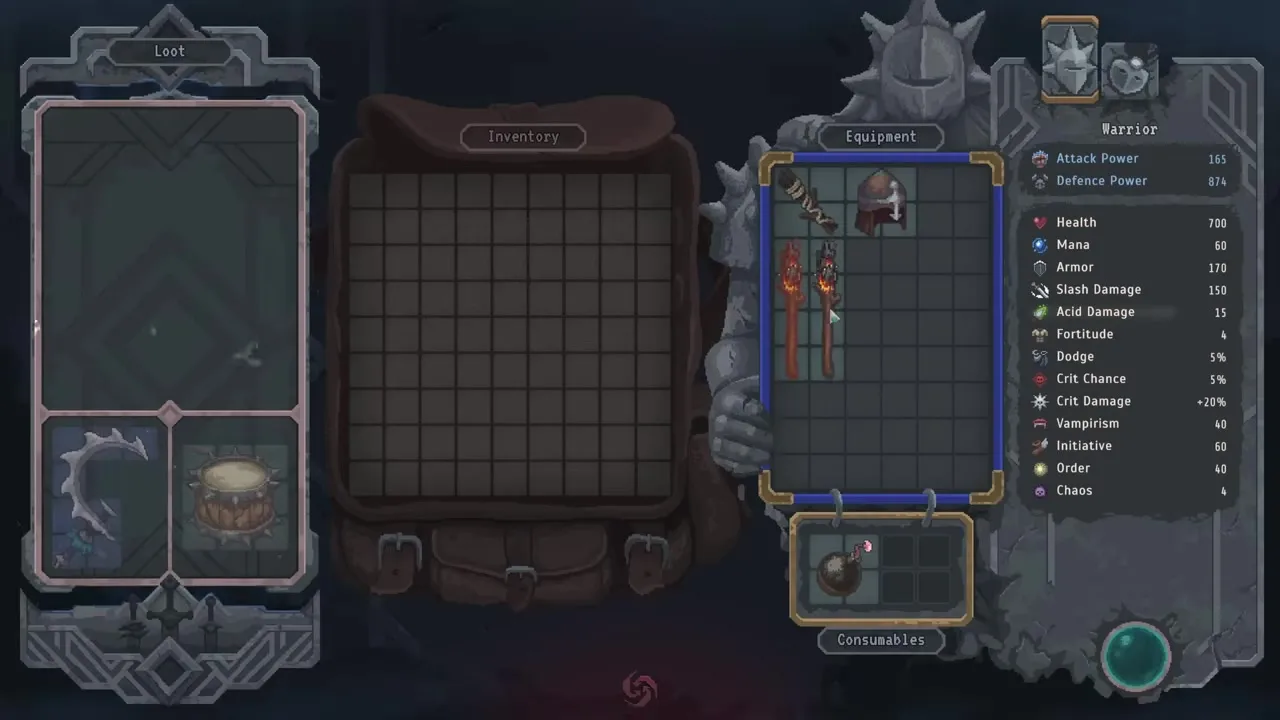
Sprinkling Dodge, crit, Acid, and Slash on one body makes an average character. Early writeups call this the generalist trap. The hero should speak one language until a recruit exists to speak the second. Paladin opener → Order and plates. Warrior opener → Slash, crit, vampirism. Witch opener → Acid and Chaos. Bard opener → instruments and Order, then grab a tank or slasher first.
1.0 parties usually field three of four classes — Steam only promises companions join along the route. The recruit is not a junk drawer. If the hero is all Slash, the first body should bring Crush or Acid — not a second slash bar. Stash the role-wrong shape for that grid instead of breaking the live cluster.
Once two boards are in play, the kit is a damage language, not a portrait. Name the types next.
A Lootbound kit is the type the neighborhood actually deals after auras fire. Seat a Crush contact against a Slash bar and plated trash finally dies; slide it off and you are tickling armor again. Specialize per body. Cover types across the party.
| Type | What it does | Who usually owns it | Needs a partner |
|---|---|---|---|
| Slash | Cuts Health once armor is gone | Warrior — crit and vampirism scale it | Crush or Acid, or it stalls on plates |
| Crush | Breaks armor | Whoever found the crush piece — often a recruit | A Slash finisher on another grid |
| Acid | Skips armor, hits Health | Witch | Mana; Chaos if you are cursing |
| Chaos | Strengthens debuffs | Witch | A real kill lane — Chaos is not a third slasher |
| Base | Untyped leftover | Anyone, early | Do not rebuild a district just to chase it |
One body strips the plate. The other deletes Health. Two Slash grids on a plated elite is two people hitting a wall. If you never found Crush, Acid on the Witch is the skip — that is why “acid on a slash build” is a real first-run question, not a meme. Full matchups: damage types.
Steam: collect a separate set of equipment for the hero and each companion. Lootbound builds live on those three boards. A Bard instrument lock does nothing on the Warrior grid, and a Paladin Order aura does not leak onto the Witch.
| Grid | Lane to pack | Typical lock | Do not |
|---|---|---|---|
| Hero (you click) | The language you spend Mana on | Whatever the starter actually swings | Park the only potion on a recruit |
| Warrior | Slash · crit · vampirism | Swords / offensive neighbors | Clone a second Slash if plates remain |
| Paladin | Armor · Health · Resistance · Order | Plate | Force a huge damage slab that deletes Order |
| Witch | Acid · Chaos · Mana · debuff | Acid / curse neighbors | Stack Order “just in case” |
| Bard (Jester alias) | Order · Dodge · instruments (names TBA) | Instruments | Score the Bard on personal Slash |
You never get a second control stick. A Bard-style support often spends a better buff when an ally is hurt; a Witch-style kit often spends a stronger curse when one enemy remains — treat exact thresholds as TBA. You seat the stats that make the automatic turn worth taking. Turn order: combat.
Lift the hero kit, move the role-wrong pieces onto the new body, then seat new loot. Consumables stay on the hero when that 1.0 rule is confirmed. A potion parked beside a damage aura on a companion bag is a wasted edge.
Two packed roles still fail if you wipe them after every loot card. The mid-page table is the commit / slide / rebuild call.
Use this after the outline is green and the tooltip is read. Stats are the last column. A one-cell slide is the default. A full wipe is for a dead kit, a new recruit, or a biome gate — not every loot card.
| Situation | Commit / keep | Slide one cell | Rebuild / drop |
|---|---|---|---|
| Aura lit, one neighbor illegal | If a second legal piece already sits opposite | Swap that neighbor onto a legal side | If no legal type exists on this character |
| New piece is the missing Crush or Acid | Yes — that is the second language | Park it on the recruit who has the hole | If it deletes the only working Slash cluster and you have no other kill lane |
| Better raw stats, worse footprint | If you are empty on that stat | Try every facing first | If the old shape feeds two auras |
| Duplicate of a seated piece | Only if the aura wants that type twice | Stack on the other grid | Pure overlap on one body |
| Wrong type for the next biome | If this node still dies to the old type | Slide it into a Crush / Acid district — damage types | If the whole party speaks one language and plates remain |
| Companion bag is hollow, hero is dense | Hero keeps the working cluster | Move the extra aura to the recruit | Do not clone the hero kit onto every grid |
| Blacksmith / gem room | Enchant the piece that will still sit two biomes later | — | Do not gem a temp shape you will drop at the next recruit |
| Biome-end Boss Part | Pick the part your three lanes can actually fight | — | Do not skip the choice to “save” a pretty pack |
What type does it buff? Does a legal neighbor already exist? What contact dies if I force the new shape? If the last answer is “the cluster carrying the run,” leave the drop on the floor. Empty cells are future auras, not wasted space.
Rebuild when a Boss Part or a new recruit changes the job. Changing one weapon can mean moving five others — that is normal, not a failed run. The inventory page is the rotate-and-seat habit; this table is when to stop fidgeting and take the node.
Once the habit is “slide first,” you can name the first-run lanes without turning them into a fake tier list.
Matched by build plan, shared topics, and guide progression — not random related links.
These are jobs, not ranks. There is no verified S-tier screenshot and no official unique list. Use the table to pick a lane you can actually pack from early loot — then cover the missing type on a recruit.
| Lane | Hero lean | Party job | Stalls when |
|---|---|---|---|
| Slash / crit / vampirism | Warrior — crit chance, crit damage, weapon hits | A recruit brings Crush or Acid | Every grid is Slash and the elite is plated |
| Crush + Slash pair | Whoever found Crush strips armor; Slash finishes Health | Do not clone the same type twice | You gemmed Crush onto a body that never swings |
| Acid skip | Witch — Acid, Mana, then Chaos | A Paladin or Warrior holds the line | No Mana left for the biome gate |
| Order tank | Paladin — Armor, Health, Resistance, Order | A Warrior or Witch actually kills | You scored the Paladin on personal Slash |
| Chaos / debuff | Witch — Chaos + Acid; companions apply the curse | Someone still has a kill lane | You sprinkled Order onto the same board |
| Support core | Bard (Jester) — Order, Dodge, instruments (TBA) | First recruit is Warrior or Paladin | You routed past the first companion room |
Slash eats Health after armor is gone. Three Slash grids on a plated elite is three people hitting a wall. Crush or Acid has to live on someone — usually the Witch, sometimes a crush piece you parked on the Warrior. That is synergy. A copied “best Warrior crit build” that never answers plates is a first-biome wipe with extra steps.
Steam / Xbox goals name the four classes and “unlock all abilities” for each. Those are meta hunts, not first-run Lootbound builds. Finish a Difficulty I party that covers a kill lane, an armor answer, and a way to stay alive before you chase named achievements. List: achievements.
If the run still dies after a legal trio, it is usually a process error — not a missing legendary name.
Scan this at the loot card and the companion door. Situation to action — not another loop recap.
| Mistake | Fix |
|---|---|
| Searching for a ranked unique kit | Commit a language + aura contacts. Names stay TBA |
| Sprinkling Slash, Acid, Dodge, and crit on one body | Specialize the hero; cover the second type on a recruit |
| Cloning the hero kit onto both companions | One Slash, one Acid/Crush, one Order/armor — classes |
| Seating rarity before contact count | Keep the common piece that sits in two auras |
| Waiting for companion hotkeys | There are none — combat |
| Mixing Order and Chaos on one grid | Paladin/Bard = Order. Witch = Chaos |
| Scoring Bard on personal damage | Read the other two bars after the Bard acts |
| Rebuilding after every drop | Slide one cell. Full wipes are for dead kits |
| Blacksmithing a temp shape | Gem the piece that will still sit on a role grid two biomes later |
| Skipping the Boss Part to protect a pretty pack | The part is the next fight — bosses |
Before you leave the pack screen, name the type each grid deals and whether a legal aura still shares an edge. If a lock died, slide. If a piece is lonely, drop it. If plates remain and nobody speaks Crush or Acid, that is the next loot you keep.
When that is automatic, the sequel is the type chart — how Slash, Crush, Acid, and Chaos actually meet armor — not another portrait page.
There is no verified ranked list. Start from class + aura adjacency + a damage type the next biome respects. Cover Slash or Acid/Crush across the party, not on every grid.
No official one. Treat community “best builds” that name uniques as TBA until those items are logged. This page uses lanes (Slash, Crush+Slash, Acid, Order tank, Chaos), not ranks.
Three parts: auras that fire on legal neighbors, a damage language (Slash, Crush, Acid, Chaos), and three separate class grids. Moving one cell can rewrite the kit.
Give Crush or Acid to someone — usually a Witch recruit, or a Crush piece on the Warrior. Two Slash clones stall on plates.
Yes if plates remain and you have no Crush. Keep Acid on the Witch grid when you can; do not sprinkle it onto a Paladin Order block.
No. Each body has its own grid. Pack the lock on the character who can use that item type — auras.
Paladin or Warrior for a clean first biome. Witch if you want Acid early. Bard last unless you grab a tank or slasher at the first companion room — classes.
No. Slide one cell first. Full wipes are for dead kits, new recruits, and biome gates.
The damage types page — it is the armor-counter chart your lane has to pass. Then combat for hero-only turns.
August 15, 2026
Matched by build plan, shared topics, and guide progression — not random related links.